Showing posts with label Day Job. Show all posts

Thursday, February 26, 2015

TBT: Taking Criticism Gracefully Can Make You a Better Writer


I recently blogged about how I tackle revisions to a MS. But a large part of surviving the crit process has to do with skin. As in thick skin. And having it. Because having thick skin is a necessity in the book biz. In fact, it’s a necessity in a lot of businesses.

I wrote today's TBT post back when I struggling to commit 100% to my Day Job.
I wanted to throw myself into my writing and never turn back. But Handsome Jack and I needed money (and still do - you know, for bills and food and stuff). So I had to keep working. At first, keeping the Day Job felt like a waste of time. I could be learning and growing as a writer instead of toiling away as a paper pusher. To make my job more bearable I started looking for connections between my Day Job and my writing career. Essentially, I was looking for ways to grow as a writer while maintaining a traditional 9 to 5. What I found was there are many lessons we learn every day, just through everyday life, that can make us a better story teller and a better writing professional.

For today's TBT I'm sharing How The Day Job Can Make You A Better Writer: Taking Criticism.

Enjoy!

-----------------------------------------------------------------------------------------------------

Criticism is a valuable part of the writing-publication journey. In this business there is no end to criticism one receives and that's not necessarily a bad thing. Criticism makes us stronger and forces us to grow. Perhaps one of the most humbling and important lessons I learned was how to take criticism gracefully.

Listening to suggestions or negative feedback about your 80,000 word baby is hard. No - It’s FREAKING hard. But it’s essential to becoming a better writer.

This time of year at the Day Job (DJ) we are going through year-end reviews. A big formal way to receive criticism about your work. There are people who are better at this than others. Some bosses pack the year-end review with feedback you've never heard before. This type of criticism is a confidence grenade and can leave you in a million little pieces. Then there are the bosses who are totally upfront. You've heard from them all year about the things you need to work on and you know where you stand.

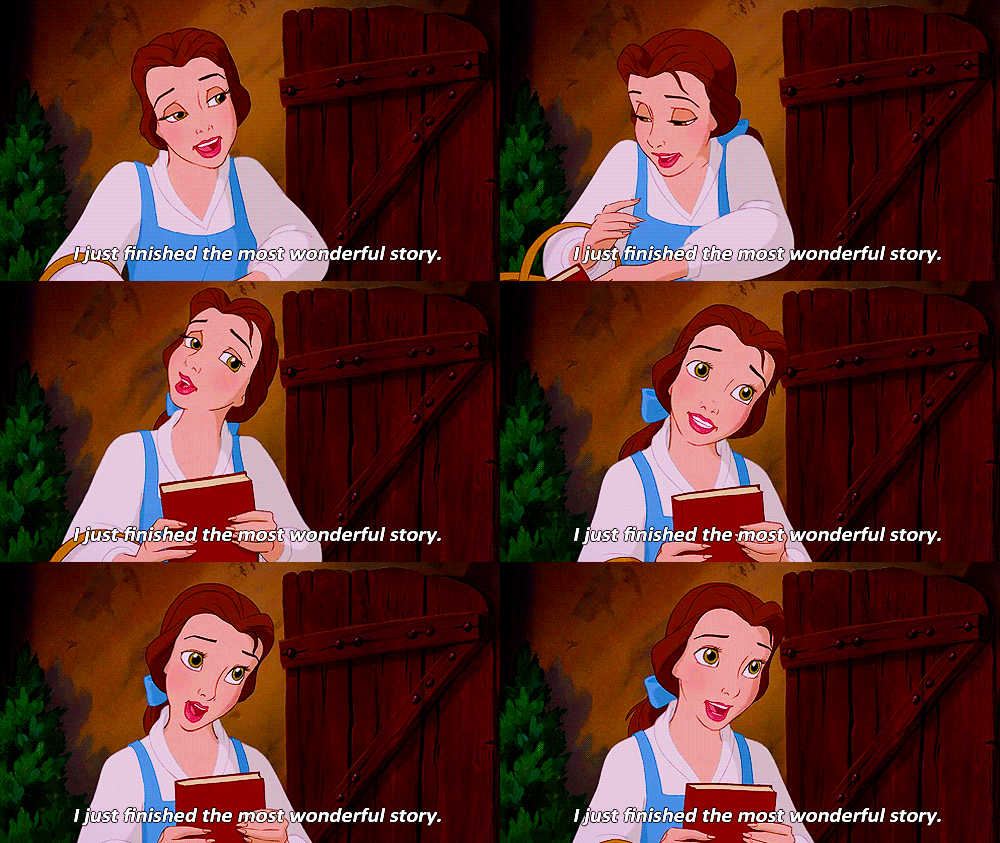
Luckily, with few recent exceptions, my DJ bosses have been in the latter group. I’m constantly receiving feedback about my work: Like when my boss tells me she hates how I handled the conference call, or my team tells me they think I could do a better job of communicating standards and goals, Or when my peers just flat out think I suck at my job. Receiving criticism can feel a lot like this:


Getting feedback isn’t enough. How you handle that feedback is what matters. That little elephant get's back up. So should you.

If you received difficult feedback at the DJ you would never dream of firing off an angry email to your boss telling them how wrong they are. Not if you expect to stay employed, anyway. When it comes to our DJ's we've learned to take criticism gracefully (even if that means going to an empty parking lot where no one from work can see you cry).

Experts at taking criticism gracefully seek the constructive in the negative. The goal is to learn from feedback (no matter how much the feedback hurts to hear).

In writing we have a ton of 'bosses' giving us constant feedback: Agents, Editors, CP's, and Readers. If we are going to grow we'll need to learn to turn criticism into improved craft.

I was reminded of this a few years ago when I won a crit for a super-awesome-famous-cooler-than-cool HarperTeen editor. I was thrilled and honored to have someone so knowledgeable reading my work.

The editor read my first 25 pages which included a prologue. (*cringes at use of prologue*) I know, I know. But I'd heard all the advice about 'hooking readers immediately' and 'opening with action' so I figured the best way to do that was with a prologue.

The HarperTeen editor said the prologue didn't work in my case. She agreed that it was action packed but stated the reader wouldn't give two flips about the characters or the action because they didn't know the characters. (I'm paraphrasing here because the super-awesome-famous-cooler-than-cool HarperTeen editor was professional, generous, nice and really sweet about the entire thing. The point is, the feedback, no matter how kind, can sting.)

By dropping the reader deep into the action without allowing them to invest in the characters my 'thrilling' scene was boring and tedious. The editor urged me to reconsider my opening and suggested I start with a normal day-in-the-life-of-the-MC. That way the reader could get to know my character.

I hated her idea. I was a little smug about it too (I'm ashamed to say). But I didn’t tell her that. I thanked the super-awesome-famous-cooler-than-cool HarperTeen editor and focused on all the feedback that really clicked with me.


I chewed on her feedback (aka criticism) for months. How am I supposed to hook my readers if the story opens with a normal boring day?


I ran through all the reasons why her idea was bad.
Why my current opening was awesome. How I could never make her idea work in my narrative, yadda yadda yadda....until it hit me: the tiny pebble of truth (or in this case a giant boulder of truth). Her idea was AWESOME! It was just freaking hard and I didn't like that. Her idea challenged me and I didn't like that. It meant a huge rewrite of the first half of the book and I didn’t like that.

When I decided to try the editor's idea I was really pleased with the result. I even did a few happy dances:


Turns out it's possible to hook a reader even if the story opens with a 'normal' day.

It can take time to understand advice that, at first, seems like criticism. If you can master this you'll be successful at anything you set out to do. This is especially true in the wild world of writing where criticism is constant.

Good writers aren’t born, they're made. They train and work hard. They learn and grow. Take this time to thicken your skin and you'll be better for it. Just another way the DJ makes us better writers.

Have you learned to take criticism with grace? What helped you get a thicker skin? Share your stories here:

Want more on taking criticism? See Chuck’s ideas on getting the most out of a crit

Tuesday, January 7, 2014

Write Foot Forward: running as a writer


Having spent most of last year trying to cultivate a thankful heart around writing and working a Day Job I feel I know a thing or two about making connections. see, when you’ve hung your hat on being a writer and all gears shift toward achieving that goal it’s frustrating as hell to slog through traffic everyday and waste precious time at the Day Job. But I also knew I couldn't just quit the Day Job and write without getting paid (momma’s gotta pay the bills). Check out this great post by Chuck Wendig on writing full time.

So some attitude adjustment was needed.

Not just a minor adjust - a major adjustment. I couldn't slap a band aid on this issue. I needed a Day Job and in order for me to find peace I needed to find a way to marry my Day Job and my writing (connections). I looked for ways the Day Job actually made me a better, stronger writer.

Huh, you say. How can that be?

Day jobs help writers so much, whether it’s cultivating discipline, providing stability, or developing the oh-so-necessary, thick skin. These posts opened my eyes to the ways the world around us resonate with story telling elements. You know, the small stuff that permeates daily life unnoticed but is so deliberate when we craft our novels. Yeah, that stuff.

Late in 2013 I started running again. Not much, but a little here and there. I ran a few 5k’s and had a lot of fun. It was like I was coming home. And when I was pounding the pavement, in the zone, I was struck with the many, seemingly obvious, connections between writing and running (I feel a series coming on). Here are some ways the two disciplines are similar:

1. Running is Competitive – Less than 1% of the worlds population has run a marathon (I’d call that pretty flipping elite). Sound familiar? I couldn't find the specific numbers on people who have finished a novel but it's so, so similar.

2. It’s a Lonely Road – you can have a coach in writing and running but you, alone, must do the work. And in both, the work is long and lonely

3. Hard as Heck – Running aint easy. Neither is writing. Both can be miserable on their worst day and pull-your-hair-out-hard on their best days

4. Powered By You – External rewards cannot be the motivating factor, in either pursuit, or you will be doomed to fail. Because so much of success is out of your control in publishing and running to be satisfying you have to be driven from within.

5. Training Needed – Both pursuits require a boat load of training. Whether your train by reading, writing, or taking classes you better strap in because there's a boat load of it coming your way.

6. Require Rest – You think you can run 12 hrs straight? I doubt it. Same with writing. And even if you could, the quality would suffer.

And let's not forget that both running and writing, if done properly, are a form of art. Or when a runner gets in their groove for a long run they end up smelly and needing a shower, just like writers. Cuz, when the words are flowing I'm like: Showers?


But above all, writing is like running because both require solitude, discipline, and strength.

I have so much more to say on this topic I'll be revisiting it from time to time to expound. Examining the ways the Day Job helped me as a writer was motivating and empowering and I hope this exercise will be as well. LOL, exercise. Did you see what I did there?

Are you a runner? Do you see parallels between running and writing? If so share them here:

Tuesday, November 19, 2013

Another Day, Another Day Job – the end of my parole from Corporate America


I realized that this week marks my last week of freedom from the Day Job. You may remember when I blogged about getting laid off, or paroled as I called it.

At the time, getting laid off felt like failure – much the way a rejection from an agent can feel like failure. In reality, getting laid off was anything but failure.

I’ve had a good deal of time to myself over the last few months and I realized something:

I’m absolutely grateful for it. The time off has been a gift. I a gift I spent on me.


I rested.


I finally caught up on some long overdue sleep. It cannot go without saying how much our bodies need sleep. I’m so thankful I had time to rest.


I read.


Oh boy, I read a ton of books. Well, 15 to be exact. It felt good to get lost in books without having to worry about being late for something. I’m grateful I had the time to read.


I wrote.


A lot. I wrote more than 111,000 words since I was laid off. I finished two MS’s and started work on a third. I’m grateful I had time to dedicate to my craft.


I spent time with friends and family.


My sister got married and I was free to spend as much time with her as possible. But that wasn’t all. There were meetings and parties and lunches. I am grateful I had so much time to spend with friends and family.


I interviewed.


I spent a lot of time interviewing for prospective jobs. I had a few great offers but in the end I selected the Day Job that will best fit for my life. I’m eternally grateful to my colleagues and network who helped connect me with the decision makers.


None of those things felt like failure to me.

Next week I will begin life at a new Day Job and all the madness that goes along with it.

I can say, with a thankful heart, that I come to this next challenge fresh and ready to learn.

Thursday, September 12, 2013

Attitude: you gotta have a good one


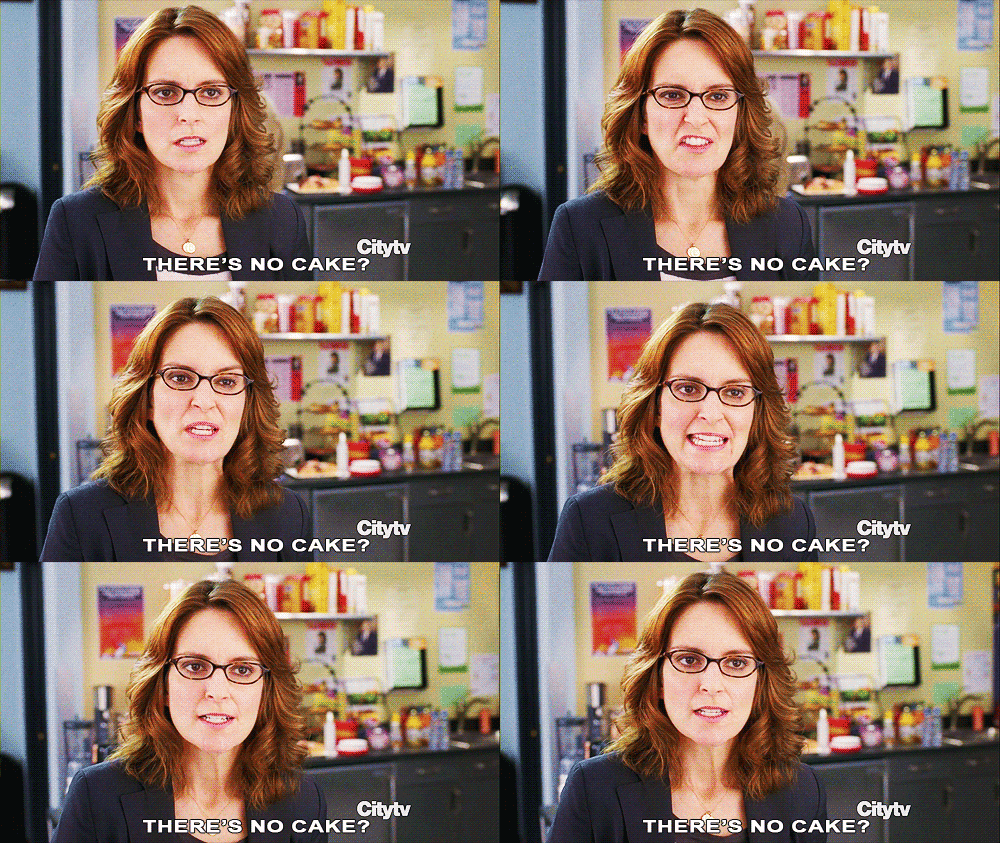
Life is a biotch, sometimes. None of this 'life can be a biotch' or 'is occasionally a biotch'. It is a biotch, sometimes. Sometimes there's no cake.


Or worse, sometimes you get stuck with a big, clunky cliche when we want fresh, original words. Pretty much everything in life is outside of our control, with one, little exception: you.

You can control you. In fact, it’s the only thing you can control. So that means the only thing standing between you and the life you want to lead is you.

It’s a hard pill to swallow. And this pill isn’t a one-and-done sort of thing. You have to swallow this giant, horse-pill-of-truth Every. Single. Day. Sometimes twice a day. Sometimes more. Sucks.


Or does it?


I think Liz Lemon would agree that the only thing within our control is our attitude, actions, and reactions. Get a rejection? Get back to work. Get laid off? Make the most of it. Get promoted? Be thankful. Work with jerks and A-holes? Find a new job.


You may remember a recent post where I mentioned the need for elephant-thick skin in life, and especially in writing. I think this goes hand in hand with attitude.

I was recently reminded of this when I was laid off from the Day Job. It’s easy to fall into a self-deprecating shame spiral when bad things happen. Get laid off, shame spiral. Get a rejection, shame spiral. Gain a few pounds, shame spiral. Just a normal week in the life of this girl. I certainly felt pretty crappy for several days after getting paroled form Corporate America (see my post here in which I wear my sad-girl, Goose Sweatshirt).

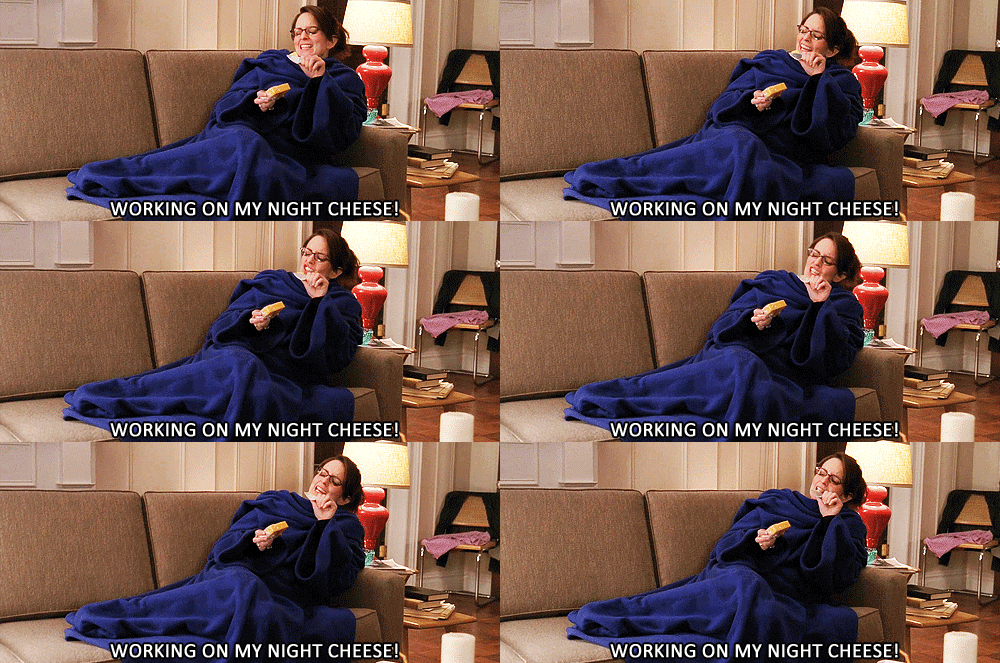
It's okay to indulge for a little while. Heck, even Liz has her night cheese.


But feeling bad for yourself doesn’t change anything. Wearing my Goose shirt wasn’t going to get me another job. It certainly wasn’t going to help me finish my WIP. Or my edits. And it certainly wasn’t going to clean the house.

The challenge in writing, as in life at large, is to see the opportunity in each difficult situation. Or as this quote eloquently states:

“What is the difference between an obstacle and an opportunity? Our attitude toward it. Every opportunity has a difficulty, and every difficulty has an opportunity.”
― J. Sidlow Baxter

How can I make the best of this? Notice I said ‘How can I make the best of this’. Not, how can they make this better for me. Not, how can he/she make me feel better. Not, they owe me.

What can I do to improve? Because that’s all there is. I. Me. Alone in this quest toward publication. I have teammates supporting me along the way but I have to do the work. And believe me when I tell, this sumbitch takes a lot of work and I’m happy to do it.


I’m excited to hit new milestones. I’m excited to learn and grow – even though growth hurts. In difficulty, there is opportunity. And I’m wearing my big girl panties and matching bra. I’m ready for it. *pulls on shit kicking boots* Bring it on.

Need more on how our Day Jobs can make us better writers?

Check out this post about taking criticism.

Or this post on Stability and Creativity.

Or this post on Discipline - you gotta have it.

Wednesday, June 19, 2013

Avoiding Neckbeards - aka setting new goals

Now that I find myself paroled from Corporate America I have a lot more time on my hands. Time for reading, writing, and blogging. I can no longer use the go-to excuse:


But time can also be a problem. A person can literally drown in too much free time. I’ve seen it. Not pretty. See neckbeard below:


I'm about two days away from being that guy. So I feel like it’s time for a new set of writing goals. Call these short term goals – since the length of my parole is undetermined. And I think it’s important to articulate the non-writing goals along with the writing goals. Why not? Right?

New Short Term Goals:

1. Wake up at a decent time – no sleeping in

2. Work out regularly (it always sparks ideas). I’m thinking running, or Zumba, or something

3. Write 5 days a week for 4 weeks

4. Spend time at the pool, because, you know, who doesn’t want to spend time at the pool?

5. Post three blogs a week

6. Clean one item (floors, counters, bathroom, etc) in the house every other day

7. Finish draft of WIP

8. Read, read, read

9. Go to bed at a decent time each night – no staying up too late to finish goal 5, 7, or 8

I’m sure I’m going to miss a few of these goals. I'm going to go ahead and say the chores goal is a long shot. Unless there are cute kittens available to assist.


Anyone who diets knows that there are days when your resolve crumbles and you just pig out on chocolate and potato chips (wait, chocolate covered potato chips sound really good right now. Are those a thing?).

Losing your willpower for one day, or even a few days, doesn’t have to derail your goals. I mean you wouldn’t get rid of your car if it got one flat tire.

The point of setting goals is to whisper the ideas out loud. Document them. When you breathe life into them they gain momentum and momentum is a powerful thing.

What do you do to gain momentum?


Need more on how our Day Jobs can make us better writers?

Check out this post about taking criticism.

Or this post on Stability and Creativity.

Or this post on Discipline - you gotta have it.

Thursday, June 13, 2013

Paroled From Corporate America - part 2 dealing with disappointment

At its heart, disappointment is a big, itchy symptom of change. If you missed my earlier post on disappointment/change, check it out here.

Like a festering, oozing case of poison ivy, change is uncomfortable. Usually because we didn’t want it in the first place or didn’t see it coming. If you’ve been following my blog you know that I’m about to begin a parole from my Day Job (aka, I got laid off).


And as fun and shiny as a lot of time off sounds it tastes bittersweet.

With any change there are three stages:
Disorientation
Reorientation
Commitment

At first I thought I was still firmly entrenched in the disorientation phase. I’d be lying if I said I wasn’t bitter or disoriented. But I realized that I’ve actually been on a rollercoaster speeding through all three phases. It’s like a ride that has a busted lap bar and I’m stuck repeating it over, and over, and over again until maintenance can bust me out.

Luckily, I’m not too far gone to realize this life lesson has some real parallels to publishing.

Whether it’s a query letter that fails to find its audience or a published authors’ newest MS that fails to earn a book contract – writers get ‘fired’ a lot. I think it comes with the territory of playing in the subjective, entertainment space. Of course, it's not all bad, as Jess so eloquently states below:


Anyway: Let’s dissect my termination experience to see what gems we can take away.

Disorientation: Some things don’t work out the way we want them to. Or throw ‘want’ out the flipping window. Sometimes life surprises us and things don’t work out the way we ever imagined. It sucks but you wake up each day, get dressed, and keep breathing. At least I do.

Reorientation: This is flight or fight. I generally opt for fight but you may feel differently. I’m currently dipping my toe into these waters.

Maybe a small voice in your head is telling you to give up? Fight it. Don’t let the nay-sayers win. Lack of confidence is common in the artist community, see Natalie Whipple’s recent post on the subject here.

Reorientation is all about digging into your reservoir of amazeballs determination. It’s all about pulling yourself out of the vat of self-pity in which you’ve been wallowing. But that’s not to say I haven't had a good cry (or two three four five...) during the reorientation phase.

Oh, I cry. A. LOT.

But I do it at home, where no one is watching.


I feel the feels and then I move on.


This, my friends, brings us to the final stage of coping with change: Commitment.

Through all of my days on the DJ and query trenches I’ve learned there is only one thing we can control, and I’ll give you a guess what it is (hint: It’s not the agent or editor reading your query – I’ve already tried my mind control techniques to no avail).

The only thing we can control is us. Our attitude. Our drive. Our will to never give up. That’s the one thing we can control and we must. It’s our true north. It’s our compass that will lead us out of disorientation and back into the world. We must be the masters of our spirit because if we let ‘them’ beat us down and push us around we wilt away to nothing. At least I do.

I can’t tolerate long in a place where my voice is not heard.

So the more I write about publishing and the more I throw myself into this field I see that this life, writing, is really self employment. And that’s true whether you go trad pub or indie pub. You control your fate, to a certain extent, because you control your attitude.


This situation is entirely within your control – because you are the situation. You decide how you’ll face today, and tomorrow, and the next day. You decide which fork to take in a yellow wood.

Commit to it. And yes change is hard, but it’s your move. What will it be?


Need more on how our Day Jobs can make us better writers?

Check out this post about taking criticism.

Or this post on Stability and Creativity.

Or this post on Discipline - you gotta have it.

Tuesday, June 11, 2013

Life of a Writer: Dealing with Disappointment


If you follow this blog you know I’ve been running a series of posts about how your Day Job, or DJ as I call it, can make you a better writer. So far we’ve covered everything from how your DJ can inspire you to build complex worlds to how the DJ can reinforce the discipline needed to actually finish that gawd-dernd-draft.

But today I’m not talking about something so pretty. There are some dark and dirty things the DJ can teach you. I need to talk about something very real, and a little emotional.

Disappointment.


As writers disappointment or rejection lurks around every corner and plot turn. Some might say this industry is cruel but I think it’s clever, really. I mean writers as a general rule are a sensitive lot. Forcing us to go through the publishing equivalent of the Hunger Games for the top prize of an Agent or book contract will certainly weed out the disappointment-adverse writers leaving more Agent’s for the rest of us.

What better way to prepare for the barrage of disappointment waiting for you in the pub world than a trusty ol’ DJ? The DJ is also ripe with disappointment. DJ disappointment comes in all shapes and sizes:

Maybe a coworker throws you under the bus during a big meeting. Maybe your office manager replaced the coffee with hot tar from the parking lot. Maybe that masterpiece of a spreadsheet you worked on for three hours vanishes without a prayer’s chance in hell of getting recovered.


Whether you’re getting a crappy review from an absentee boss, losing the big account to a competitor, or getting laid off, the DJ is a great place to hone the skill of recovering from disappointment.

A thick skin and stubborn, ‘never-give-up’ attitude can take you far in life.

Do you have a thick skin? How did you get the ‘never-give-up’ attitude?


Want to read more about Disappointment? Try this post by FinerMinds.

Need more on how our Day Jobs can make us better writers?

Check out this post about taking criticism.

Or this post on Stability and Creativity.

Or this post on Discipline - you gotta have it.

Wednesday, June 5, 2013

Who Still Needs a Security Blanket? This Girl.

I have this sweatshirt. It’s ugly and old and definitely stained. It’s faded and dated and is generally thought to be hideous.

So of course I freaking love this sweatshirt. Check it out:


I first came across it when I was house-sitting for my in-laws. The sweatshirt was hanging in my father-in-law’s (FiL’s) closet. I totally couldn't resist making fun of it. Because, come on, it’s a sweatshirt from the eighties with geese on it. And it was apparently worthy of a hanger. Which is saying a lot because, frankly, not everything is worthy of a hanger. Some clothes deserve to be hidden in the dark recesses of a dresser.

Weeks went by and I totally forgot about the ancient sweatshirt until I was at my in-law’s and was terribly sick. I had a fever and chills and was miserable. I asked for a sweatshirt, something I could just wear for the car ride back to our house, because I was so flipping cold. My FiL went immediately to his closet and offered me, none other than, The Goose sweatshirt.

I didn’t laugh or snub it. I was thankful to have it and I pulled the old, baggy thing on immediately. I feel asleep with my arms and legs tucked inside The Goose sweatshirt.

I had every intention of washing the thing and returning it the next day. What reason would I have for keeping something like this? I couldn’t wear it to the office on caj Friday. But I was still feeling crappy the next day so I wore the sweatshirt while I vegged on the couch.

When I started to feel better I tossed The Goose in the laundry pile. It was clean but I couldn’t part with it. I kept it tucked safely in my closet. When I was sad, I wore The Goose, when I was PMSing I wore The Goose, when I was sick I wore The Goose.

I love this silly thing and all is right with the world. The Goose comforts me and I care for The Goose. Yin and Yang. The circle of life and all that stuff.

Then last week happened. I had a terrible week. My boss gave me terrible news:

I’m getting laid off.

I got angry. I yelled. I pouted. And I may have thrown a bit of fit. So, naturally, I needed the The Goose.

But it was no where to be found. The Goose was gone. I looked in the dirty laundry. I dug through my winter clothes. I even took my dresser drawers out and dumped them on the floor.

No Goose.

And I cried. I cried a lot.


Sure, life at work was in the pooper. Sure, my WIP has stalled. But the icing on the cake was NO GOOSE.

My hubby and sister got together and tried to find it. Luckily, after days of searching, my husband found my sweet Goose sweatshirt crammed between the wall and my dresser.

I was so happy to get my Goose back. See:


Now, making decisions about my Day Job and my WIP seem a little less scary. Welcome back Goose.

Do you have a ‘Goose’ of your own?


Need more on how our Day Jobs can make us better writers?

Check out this post about taking criticism.

Or this post on Stability and Creativity.

Or this post on Discipline - you gotta have it.

Tuesday, June 4, 2013

You gotta have it: Discipline

When you tell people you are a writer they generally react one of two ways: either they perk up and ask if you’ve published anything (believing that publishing is a giant cash cow) or they recoil from you like your disease is contagious.


Some people think writers/artists are worthless and lazy. We all live with our parents or leech off our spouses. We’re dirty because we never shower or take care of our selves. We're willing to just let the world run right over us like this cat:


Most people think we’re all maniacal drug addicts or alcoholics and if you get too close to us our disease of creativity may just spread. And with every stereo type there is likely some truth to those about writers. Well, except the contagious thing.

And although there is a stigma on those who choose creativity as a career it seems self pub or indie pub writers get it the worst.

But we can all agree that writer stereotypes are not universally true. Even though I’ve been known to skip a shower on days when I’m on a roll. I mean, yeah, who’s going to see/smell me when I look like this:


Well, other than my husband. But he’s stuck with me. For better or writer worse., right?

All that aside, I’d argue that the successful artists (however you define success) are anything but lazy.

The hottest buzzword around the pub industry is ‘writer entrepreneur’ implying that a writer is actually a self-employed, small business owner. They are the CEO, CFO, COO, CIO, and VIP of Marketing. They are labor and management. I don’t know about you, but to me, that sounds like a TON of hard work.

Avid tweeter Leigh Ann Kopans, author of the upcoming self pub’d ONE, has recently caused some waves with her posts about the work and cost that goes into launching in the self pub world. I think she later redacted her posts because I cannot find them now - but if you read them you know, they were very detailed.

Ultimately, I see hard work and discipline everyday in the pub world. These are skills, people. Hard work and discipline are learned behaviors. Sometimes these skills are handed down from their parents or pounded into us by teachers and coaches. But where we really polish our discipline is at the Day Job, or DJ as I call it.

It takes discipline to do just about anything DJ related because, let’s face it, most of us hate our DJ’s. It takes discipline to go to work, let alone actually do work. It’s easy to hate the DJ and view it as an obstacle to further chasing our dreams of becoming pub’d writers. But while we trudge through the frustration, challenges, and rigor of the DJ we are honing the ability to work hard, manage conflicting priorities, push through obstacles, and overcome.

Writers of all kinds (pre pub, self pub, small press pub, trad pub) need discipline to make it in this industry. Let’s hear it for the Day Job for helping us along our journey.

How has discipline helped you along the path to publication?

If you liked this post check out these Day Job posts:

Day Job - Stability

Day Job - Villains

Wednesday, March 13, 2013

Day Job Can Make You a Better Writer: Villains


It is a truth universally known that a good-girl in possession of a Day Job must be the target of senseless bulling. No matter what stage of life or career there will always be a villain or two lurking in the shadows, plotting your destruction. Like this guy who haunted me during my turn at McD's:


Even if you have a cush DJ at a grocery store you never know when an evil panda might strike, like this:


Most of us don’t have to look far at any Day Job to find pricks, gangsters, and goons. Sometimes you only need to look in the mirror.

Whether your DJ villain is your boss, your know-it-all coworker, or yourself, conflict drives every plot forward. Heck, we wouldn't use conflict to propel our character arcs forward if it didn't ring true-to-life.


So get inspired by real life – even the frustratingly ugly parts. Take it on the chin and then get to work. Whether you slay the dragon in real life or on in your next novel is up to you. As writers, we can use our DJ villain as fodder for the next WIP. We get revenge with pen and paper. Use your DJ angst to fuel your writer-fire. It's a hell of a lot cheaper than professional therapy.


Have you ever based a Protag off of a real life villain? Have you ever used a work conflict in a WIP?

Need more on how our Day Jobs can make us better writers?

Check out this post about taking criticism.

Or this post on Stability and Creativity.

Or this post on Discipline - you gotta have it.

Friday, March 8, 2013

Day Job Can Make You a Stronger Writer: Stability


Day Jobs can be a burden, let's be honest. They can flat out suck. But there are many reasons why a DJ can make you a better, stronger, writer. Whether it's world building or skin-thickening the DJ has it's purpose.

Most recently, I'm happy to report that the DJ is helping me become a better writer because it provides something so simple, so necessary, that it's probably overlooked. STABILITY.

Or as Mel Gibson might say: Freeeeeeeeeedoooooooooooom!


Many writers have said it before me: The DJ is the platform that allows you to write. Most recently, my DJ provided me the opportunity to pay off a great deal of debt. And when I say 'great deal' I don't mean like I got these shoes for a steal at Macy's. No. I mean huge. Stinking. Piles. of debt. School debt, car debt, credit card debt, and the list goes on and on. And it' my DJ that is slowly enabling my family to get one step closer to financial freedom.

So let's raise a glass huge-freaking-goblet of wine and toast to the DJ for the relentless way it kicks us in the ass, pushing us ever forward. Don't know how? Just follow the example set by these two mustachioed gentlemen. *Cheers*


What reasons do you have to be thankful for your Day Job? How has your Day Job helped you become a better writer?

Monday, February 25, 2013

Day Job Can Make You a Better Writer: Taking Criticism

Criticism is a valuable part of the writing-publication journey. In this business there is no end to criticism and that's not a bad thing. Criticism makes us stronger and forces us to grow. Perhaps one of the most humbling and important lessons I learned was how to take criticism gracefully. Listening to suggestions or negative feedback about your 80,000 word baby is hard. No - It’s FREAKING hard. But it’s essential to becoming a better writer.

This time of year at the DJ we are going through year-end reviews. A big formal way to receive criticism about your work. There are people who are better at this than others. Some bosses pack the year end review with feedback you've never heard before. This type of criticism is a confidence grenade and can leave you in a doubt spiral. Then there are the bosses who are totally upfront. You've heard from them all year about the things you need to work on and you know where you stand.

Luckily, with few recent exceptions, my DJ bosses have been in the latter group. I’m constantly receiving feedback about my work: Like when my boss tells me she hates how I handled the conference call, or my team tells me they think I could do a better job of communicating standards and goals, Or when my peers just flat out think I suck at my job. Receiving criticism can feel a lot like this:


If you received this feedback at the DJ you would never dream of firing off an angry email to your boss telling them how wrong they are. Not if you expect to stay employed, anyway. When it comes to our DJ's we've learned to take criticism gracefully (even if that means going to an empty parking lot where no one from work can see you cry).

Experts at taking criticism gracefully seek the constructive in the negative. The goal is to learn from feedback (no matter how much the feedback hurts to hear).

In writing we have a ton of 'bosses' giving us constant feedback: Agents, Editors, CP's, and Readers. If we are going to make it in the pub world we'll need to learn to turn criticism into improved craft.

I was reminded of this two years ago when I won a crit for a super-awesome-famous-cooler-than-cool HarperTeen editor. I was thrilled and honored to have someone so knowledgeable reading my work.

The editor read my first 25 pages which included a prologue. (*cringes at use of prologue*) I know, I know. But I'd heard all the advice about 'hooking readers immediately' and 'opening with action' so I figured the best way to do that was with a prologue.

The HarperTeen editor said the prologue didn't work in my case. She agreed that it was action packed but stated the reader wouldn't give two flips about the characters or the action because they didn't know the characters. (I'm paraphrasing here because the super-awesome-famous-cooler-than-cool HarperTeen editor was professional, generous, nice and really sweet about the entire thing.)

By dropping the reader deep into the action without allowing them to invest in the characters my 'thrilling' scene was boring and tedious. The editor urged me to reconsider my opening and suggested I start with a normal day-in-the-life-of-the-MC. That way the reader could get to know my character.

I hated her idea. I was a little smug about it too (I'm ashamed to say).

How am I supposed to hook my readers if the story opens with a normal boring day?


I chewed on her feedback (aka criticism) for months. I ran through all the reasons why her idea was bad. Why my current opening was awesome. How I could never make her idea work in my narrative, yadda yadda yadda....until it hit me: the tiny pebble of truth (our in this case a giant boulder of truth). Her idea was AWESOME! It was just freaking hard and I didn't like that. Her idea challenged me and I didn't like that. It meant a huge rewrite of the first half of the book.

When I decided to try the editor's idea I was really pleased with the result. I even did a few happy dances:

Turns out it's possible to hook a reader even if the story opens with a 'normal' day.

It can take time to understand advice that, at first, seems like criticism. If you can master this you'll be successful at anything you set out to do. This is especially true in the wild world of writing where criticism is constant.

Good writers aren’t born, they're made. They train and work hard. They learn and grow. Take this time to thicken your skin and you'll be better for it. Just another way the DJ makes us better writers.

Have you learned to take criticism with grace? What helped you get a thicker skin?

Friday, February 15, 2013

Day Job Can Make You a Better Writer: World Building

In this series I plan to explore ways the Day Job can actually improve your writing. One super huge way in which your Day Job can make you a better writer is World Building:

All jobs are full of jargon, legacy, and ritual. Immersing yourself in the wild world of the DJ helps exposes you to the rich detail of another world. Albeit, the other world may not be glamorous or involve hot guys who slay dragons. *sigh*

I work in the health care industry which has a lexicon comprised of acronyms (HMO, PPO, DMO, HRA, FSA, etc.), jargon (Par, Non Par, Caid, Care, etc), and even numerical codes used to represent language (99213, 99214, 99215, etc). Imagine how much I could learn if I studied the language like these hippos study...marbles:


Language is a huge component of world building. But that's not all we can learn from the DJ. There's more *said in manner of slap chop salesman*:


All DJ's have processes, procedures, and rituals that must be followed. There’s a hierarchy to the society: those in the trenches, managers, executives, and senior leaders. And most importantly every DJ I’ve held, from McDonald's to Corporate Office, has had a culture and system of values. These are all important elements of world building in fiction. Whenever I begin plotting a new WIP I ask myself these Day-Job-inspired questions:

a. What words/language will the characters use?
b. What rituals are important to the characters?
c. What hierarchy is established in this world?
d. What do the people of this world value?


Has your Day Job helped you with world building? What other things have inspired your world building?


Need more on how our Day Jobs can make us better writers?

Check out this post about taking criticism.

Or this post on Stability and Creativity.

Or this post on Discipline - you gotta have it.
Related Posts Plugin for WordPress, Blogger...