Tuesday, July 7, 2015
8 Tips for Running Injury Free
For many of us the running season is in full swing. Or, at least, the training season has begun. Woo hoo!
But with running season comes the constant plague shadowing every athlete (whether professional or not): injury. I know a lot of runners who have been sidelined with injury – including my myself and my hubby, Handsome Jack.
Staying injury free is even more important if you have complicating conditions like diabetes, osteoporosis, or arthritis. Running injuries can lead to chronic pain and, potentially, even surgery. Just ask Handsome Jack, and his 4 knee surgeries,ugh.
So before we get neck deep in long runs and foam rollers I thought I'd share some tips on staying injury free. I’ve picked these up over the years and they help me. Keep in mind I’m not a doctor or health professional. I’m just your average fitness fanatic. Nothing here is meant to treat or cure pain or injury. Now, that being said, let’s dive into my 8 Tips For Running Injury Free:
1. Build slowly – I picked this tip up from the knowledgeable folks over at Runners World. If your aiming for a long race train by slowly increasing your mileage over several weeks. This allows your body to adjust to the pounding and helps you stay injury free.
2. Rest – yes you. You need to rest. And often. Take rest days just as seriously as any other training day. Your body needs time to heal. Activity, especially intense athletic training – causes tiny tears to form in your muscles. Your body needs rest in order to heal those tears. My stress fracture occurred because I didn’t allow myself enough rest. And if you don’t know, stress fractures are nasty little things you don't want. Don’t be like me – get your rest!
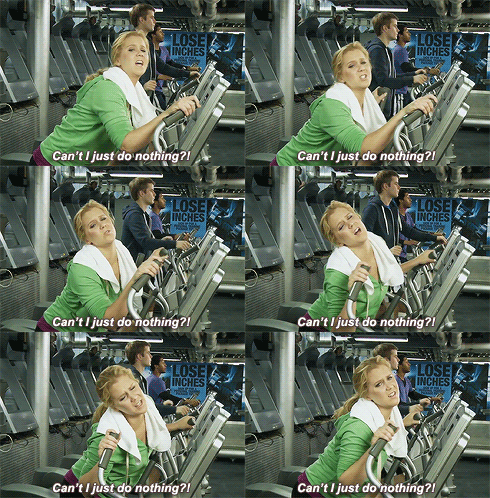
3. Cross train – Which, for most runners, cross training is a bad word. But it’s an absolute must. Early on in our running Handsome Jack suffered from ITB problems. The doctor told him the ITB problems were caused by an imbalance in his leg muscles. Essentially, his running muscles were too strong and his other leg muscles weren’t strong enough. He spent weeks in Physical Therapy building up a more balanced leg. Now we take cross training seriously and he’s been ITB pain free for years.
4. Don’t wait too long to see a doctor – Now, if you’re like me and generally healthy you probably don’t see a doctor on a regular basis. But if you are an athlete (which, as a runner – regardless of size, speed, or finishing time - you totally are) you should take your body seriously. If you are feeling persistent pain don’t ignore it. Go to the doctor sooner rather than later. Delaying could make your pain worse. Seeing your doctor early gives you the opportunity to adjust to avoid being sidelined. If the doctor order physical therapy take the therapy. Your body is the machine you use to live, work, and play. Don’t ignore the signals it’s sending or you could be sidelined for a long, frustrating recovery, and no one wants that. Worst case scenario you could find yourself suffering in a Zimmer persona malfunction issue, for example. This is a knee replacement device indicated for patients with severe knee pain. Unfortunately the device has been recalled due to a piece causing complications and has even sent patients back in for revision surgery. So please make sure you pay attention to your pain!
5. Take walk breaks when needed – When I first started running I thought I wasn’t a real runner if I took walk breaks. But the concept is ridiculous. If I’m running I’m a runner. I may not look like a runner or be as fast as another runner but I’m out there which means I’m a runner. Don’t be afraid to take walk breaks. I jammed my knee during a hiking trip two summers ago and it flares up and gets swollen from time to time (especially on long runs). I’ve had it looked at and there is no visible damage in there – so I returned to my running routine. But I listen to my knee. When it tells me to walk I walk. And you know what? I haven’t missed a race yet.
6. Eat to train – this is a big one. Eating is important to your overall health but its especially important for an athlete. Make sure you’re getting enough protein, fat, and carbs in your meals to provide your body with the fuel it needs to heal.
7. Ice and stretch – When I was in school I used to see the track kids walking out of the athletic training facility wrapped in bags of ice. Their shins, their knees, some hips and even feet would be wrapped in ice. Ice helps reduce inflammation after a workout. Use it. Some runners swear by ice baths. I haven’t tried that yet. However, I do ice my knees when they hurt and it’s a huge help. Also, stretch. Always always stretch. Now, there is debate about whether or not one should stretch before or after a workout. I don’t care. Just be sure you do. I’ve always heard long, flexible muscles are better and produce better results. Who knows if it’s true. But what I do know is that I always feel better after I stretch.
8. Don’t give up – if you are running with injuries or coming back from an injury it can feel horrible. Everything is hard on the way back to where you were. I get it. I feel ya bro. But don’t give up. Keep pushing forward. Even when you are sore and stiff. The best remedy to that soreness is working your muscles and flushing all that lactic acid out of there. Keep moving and you’ll not only prevent injuries but bounce back faster after an injury.
Those eight things have worked to keep me running for more than seven years. What works for you?
Monday, July 6, 2015
June 2015 Month In Review
**Recapping my monthly progress serves two purposes: first, it keeps me honest and accountable to my goals; second, it allows me to truly capture just how much work I’ve done over the last year. So let the recapping begin!**
-----------------------------------------------------------------------------------------------------
I don't know what to think about June other than it was a mixed bag of horrible and happy.
First, Handsome Jack and I went on our first ever cruise. It was a family vacation with his parents, his sister and her husband, and, of course, the two of us. It was a lot of fun spending all that time with them.
It was a seven day Caribbean cruise on Carnival. We hit the Nassau, Bahamas; St. Thomas, US Virgin Islands; San Juan, Puerto Rico; and Grand Turk, TCI. Here are some pics:
You may think being crammed on a boat for seven days with your family would be...overwhelming. I didn't find it to be overwhelming at all. In fact, Handsome Jack and I were able to spend time alone in addition to spending quality time with the fam.
On the fitness side of things, we worked out on the boat nearly every day (sometimes twice a day). On a cruise you cannot escape the food. So Handsome Jack and I made the decision to work out when we could. On our first day we went down to the gym and signed up for some yoga and spin classes. We also made sure we spent at least thirty mins each day on the elliptical.
Who says you can't stay fit while on vacation?
Now, I know what you're thinking: "Colleen, this all sounds like fabulous fun #FTW. Why did you say June was a mixed bag?"
Well, here it goes.
While we were at sea our dog, Lilly, died. She was a lovely Chihuahua we rescued 11 years ago at the age of five. Recently, she had developed some health issues but we were treating them with medicine and everything appeared to be well controlled. When we left for our cruise we boarded Lilly with her vet. They absolutely loved her there and I knew she was in good hands. Sometimes there is nothing you can do. It was her time.
Her passing has ripped a massive hole in our lives. Everyday we do another task that reminds us she is no longer here, like opening the back door to take out the trash and pausing for Lilly to come running (she loved the back yard).
She was a good dog and we were honored to have shared our lives with her these past 11 years. Perhaps one day there will be another puppy in our house and hearts, but for now we grieve.
So here are the details for May 2015:
1 Amazing, fun, family cruise
1 tragic,no-good, very bad loss of the cutest puppy ever (RIP Lilly Pill)
1 Day Job trip to Connecticut
13 gym workouts (mostly cardio including a 6.2 mile run, 2 yoga classes, and 1 spin class on the boat!)
2 books read for fun
And on top of all of that I still had words. Not many, but any words are worth celebrating, right? *does happy dance* This month’s grand total is 2,919 words. My lowest tracked word count so far this year. This brings my total ‘tracked’ word count for 2015 to 43,624! Not too shabby.
And as for miles, this month’s grand total is 31 miles, bringing my total ‘tracked’ mileage to 184.3 miles. I've signed up for two 5k's and I have my eye on a few more.
All in all, June happened. And now it’s over. My memories will sustain me and tomorrow is a new day. #NeverGiveUp #NeverSurrender
How are your writing goals coming along?
Monday, June 29, 2015
What my trunk novel taught me
Alright, let’s talk about something that no one like to talk about: The novel that didn’t work.
I have some of those novels, as I’m sure you do. Every writer has a book that didn’t land an agent or didn’t sell or whatever. And in a lot of ways these novels, tucked deep into a drawer or trunk or damp dirty corner of your hard drive, can feel like failure.
Because a novel without a home is a failure, right?
WRONG.
And here’s why:
The novel that didn’t land you an agent, the novel that didn’t sell, is a lot like a game that is lost. It’s just one game. It’s not the end of the world. And sure, some sports teams can accumulate a losing season (meaning they’ve lost more games that season than they’ve won). It happens. But the team doesn’t pack up shop and go out of business when they have a losing season. The team keeps moving forward.
And so should the writer. One novel in the drawer does not a failure make. Ten novels in the drawer does not a failure make.
It’s hard to look back at the novel in the drawer and think about it as valuable but there is value in it.
I was recently reminded of this when I picked up my first novel for a re-read. Here are the 5 things my trunk novel taught me.
1. In my first novel I was huge on telling – I used to get this feedback all the time: “you’re telling not showing, show more”. But of course, that feedback alone doesn’t help me. It’s like saying to a newborn baby “you’re not using your lungs. Try using your lungs more.” Well, the baby’s not going to know what any of that means. I later had my showing vs telling ah ha moment, but that moment came after I had shelved my first novel. So, during the re-read I was blown away by how simple my telling was. Some of it was easy stuff like calling emotions by their name instead of showing the physical manifestation of the emotion. I had a lot of “Sarah was shocked. Tom was sad.” Etc. etc. I had to laugh. The value in this first novel could be summed up in one line: I saw the telling. I recognized it immediately. Which means I’ve grown a lot as a writer since then and as all writers know, growth is good. Growth is valuable.
2. My MC lacked agency – Character agency is a huge required element in strong storytelling. Not sure what agency is? Check out this post by the brilliant Chuck Wendig: Just What the Humping Heck is "Character Agency," Anyway? Go ahead and read it, I can wait. *taps foot* Without agency characters have the story happen to them – not because of them. That’s it, that's lack of agency. I enjoy stories more when the characters make choices that change the world around them. When the choices impacting a character are made by other people it’s less cool. Sure, there is the odd betrayal and what not, but ultimately, the MC needs to be the wave and the conflict needs to be the shore. Well, in my trunk novel during the climax the MC is completely reactive. In fact, her friends save the day and she does nothing (embarrassing, right?). When I wrote the story I thought the betrayal and friend intervention were great elements. But during the re-read I kept asking myself “Why isn’t my MC kicking more @s$? Why isn’t she doing something?” Now, this book was supposed to be the first in a series and I had plans for my MC to grow and have more agency in each book – which is fab. But she needed more agency in book 1. The book can’t happen to her. I need her to force the issue (because I personally enjoy that more). What was eye opening for me was that I recognized this problem right away. I got to the climax of the book and this fatal flaw in my storytelling practically slapped me in the face. Lesson learned.
3. Plotting is the bomb – When I drafted that first novel I basically let the story ramble out of me. I was the queen of word vomit. I didn’t outline and I certainly didn’t plot. I was a true pantser back then and the story shows it. Now, that’s not to say you can’t be successful as a pantser. A lot of authors do it and rock it. I’m not one of them. In my re-read I got to chapter four and spotted a plot hole. I remember a CP once giving me the feedback that elements in my story were not plausible. And at that time I understood that to mean elements/actions within my story were not properly supported by previous information or action. Which is a fixable issue. However, what’s much harder to fix are glaring openings in your plot that are just that way because – why-the-f-not-I’m-story-god. Those why-the-f-not moments don’t read as fun and cool. No, to the reader those moments are implausible. My re-read illuminated this fact for me. Plotting isn’t easy. It’s hard hard work. But plotting allows us to build a story that is plausible. And readers want believability.
4. The rule of 3 is key – What’s the rule of three you ask? Well, the rule of three is an idea that you only need to describe three things at any given time. That your character is really only capable of absorbing three things and the same is true for the reader. My first novel, may it rest in peace, is rife with over-description. And at the time I thought it made my prose pop. But when I re-read it I was blown away with how clunky it felt. My storytelling voice has evolved into a shorter, sharper, direct voice. My characters no longer seem to amble through a room remarking on every trinket and doo dad they see. I did not abide by the rule of 3 when drafting the first novel and it’s painfully obvious now. So now, I can happily say, the dude abides (the dude, in this case, being me).
5. There is no replacement for good self-editing – when I drafted that first novel I entered it in every contest I could. I got a lot of critiques from other writers but I also got critiques from editors. I won a crit of my first 25 pages from a Harper Teen editor I admired. I also hired a freelance editor to do a full edit (big picture and tight grammatical stuff) of my entire 98,000 word novel. Both professional editors offered great feedback and I incorporated their changes. But even after all that editing there were still problems. Not necessarily grammatical issues (and we’ve already covered the problems with telling) but these problems were at the basic word-choice level. What I saw in this old novel were lots of weak words being utilized. A lot of this weak language could fall into the telling category but I think it was bigger than that. In this first novel I used a lot of language that distanced the reader from the story. These words generally come in the form of sensory descriptions (he saw, she felt, it seemed, she thought, he looked, etc etc). In each case these words get between the story and the reader like wedge. I have since developed a self-editing slash list of words I try to obliterate from my MS. These distance creating words are on the list. I adopted the habit of attacking these words after hearing a lecture at an RWA conference. But it wasn’t until I re-read that first novel that I really understood the value in this approach.
In all five of these areas I saw the problems right away. I recognized these issues and that means I’ve grown as a writer. The growth is valuable. Each MS I produce is better because of the book before it. The cool thing about writing is that you can constantly improve (if you’re willing to do the work). I’m thankful I started where I did and I’m happy to be where I am. There is value in getting the words on the page, no matter how crappy, and no matter the fate of the story because even if this story doesn’t find a home, my next story might.
I have some of those novels, as I’m sure you do. Every writer has a book that didn’t land an agent or didn’t sell or whatever. And in a lot of ways these novels, tucked deep into a drawer or trunk or damp dirty corner of your hard drive, can feel like failure.
Because a novel without a home is a failure, right?
WRONG.
And here’s why:
The novel that didn’t land you an agent, the novel that didn’t sell, is a lot like a game that is lost. It’s just one game. It’s not the end of the world. And sure, some sports teams can accumulate a losing season (meaning they’ve lost more games that season than they’ve won). It happens. But the team doesn’t pack up shop and go out of business when they have a losing season. The team keeps moving forward.
And so should the writer. One novel in the drawer does not a failure make. Ten novels in the drawer does not a failure make.
It’s hard to look back at the novel in the drawer and think about it as valuable but there is value in it.
I was recently reminded of this when I picked up my first novel for a re-read. Here are the 5 things my trunk novel taught me.
1. In my first novel I was huge on telling – I used to get this feedback all the time: “you’re telling not showing, show more”. But of course, that feedback alone doesn’t help me. It’s like saying to a newborn baby “you’re not using your lungs. Try using your lungs more.” Well, the baby’s not going to know what any of that means. I later had my showing vs telling ah ha moment, but that moment came after I had shelved my first novel. So, during the re-read I was blown away by how simple my telling was. Some of it was easy stuff like calling emotions by their name instead of showing the physical manifestation of the emotion. I had a lot of “Sarah was shocked. Tom was sad.” Etc. etc. I had to laugh. The value in this first novel could be summed up in one line: I saw the telling. I recognized it immediately. Which means I’ve grown a lot as a writer since then and as all writers know, growth is good. Growth is valuable.
2. My MC lacked agency – Character agency is a huge required element in strong storytelling. Not sure what agency is? Check out this post by the brilliant Chuck Wendig: Just What the Humping Heck is "Character Agency," Anyway? Go ahead and read it, I can wait. *taps foot* Without agency characters have the story happen to them – not because of them. That’s it, that's lack of agency. I enjoy stories more when the characters make choices that change the world around them. When the choices impacting a character are made by other people it’s less cool. Sure, there is the odd betrayal and what not, but ultimately, the MC needs to be the wave and the conflict needs to be the shore. Well, in my trunk novel during the climax the MC is completely reactive. In fact, her friends save the day and she does nothing (embarrassing, right?). When I wrote the story I thought the betrayal and friend intervention were great elements. But during the re-read I kept asking myself “Why isn’t my MC kicking more @s$? Why isn’t she doing something?” Now, this book was supposed to be the first in a series and I had plans for my MC to grow and have more agency in each book – which is fab. But she needed more agency in book 1. The book can’t happen to her. I need her to force the issue (because I personally enjoy that more). What was eye opening for me was that I recognized this problem right away. I got to the climax of the book and this fatal flaw in my storytelling practically slapped me in the face. Lesson learned.
3. Plotting is the bomb – When I drafted that first novel I basically let the story ramble out of me. I was the queen of word vomit. I didn’t outline and I certainly didn’t plot. I was a true pantser back then and the story shows it. Now, that’s not to say you can’t be successful as a pantser. A lot of authors do it and rock it. I’m not one of them. In my re-read I got to chapter four and spotted a plot hole. I remember a CP once giving me the feedback that elements in my story were not plausible. And at that time I understood that to mean elements/actions within my story were not properly supported by previous information or action. Which is a fixable issue. However, what’s much harder to fix are glaring openings in your plot that are just that way because – why-the-f-not-I’m-story-god. Those why-the-f-not moments don’t read as fun and cool. No, to the reader those moments are implausible. My re-read illuminated this fact for me. Plotting isn’t easy. It’s hard hard work. But plotting allows us to build a story that is plausible. And readers want believability.
4. The rule of 3 is key – What’s the rule of three you ask? Well, the rule of three is an idea that you only need to describe three things at any given time. That your character is really only capable of absorbing three things and the same is true for the reader. My first novel, may it rest in peace, is rife with over-description. And at the time I thought it made my prose pop. But when I re-read it I was blown away with how clunky it felt. My storytelling voice has evolved into a shorter, sharper, direct voice. My characters no longer seem to amble through a room remarking on every trinket and doo dad they see. I did not abide by the rule of 3 when drafting the first novel and it’s painfully obvious now. So now, I can happily say, the dude abides (the dude, in this case, being me).
5. There is no replacement for good self-editing – when I drafted that first novel I entered it in every contest I could. I got a lot of critiques from other writers but I also got critiques from editors. I won a crit of my first 25 pages from a Harper Teen editor I admired. I also hired a freelance editor to do a full edit (big picture and tight grammatical stuff) of my entire 98,000 word novel. Both professional editors offered great feedback and I incorporated their changes. But even after all that editing there were still problems. Not necessarily grammatical issues (and we’ve already covered the problems with telling) but these problems were at the basic word-choice level. What I saw in this old novel were lots of weak words being utilized. A lot of this weak language could fall into the telling category but I think it was bigger than that. In this first novel I used a lot of language that distanced the reader from the story. These words generally come in the form of sensory descriptions (he saw, she felt, it seemed, she thought, he looked, etc etc). In each case these words get between the story and the reader like wedge. I have since developed a self-editing slash list of words I try to obliterate from my MS. These distance creating words are on the list. I adopted the habit of attacking these words after hearing a lecture at an RWA conference. But it wasn’t until I re-read that first novel that I really understood the value in this approach.
In all five of these areas I saw the problems right away. I recognized these issues and that means I’ve grown as a writer. The growth is valuable. Each MS I produce is better because of the book before it. The cool thing about writing is that you can constantly improve (if you’re willing to do the work). I’m thankful I started where I did and I’m happy to be where I am. There is value in getting the words on the page, no matter how crappy, and no matter the fate of the story because even if this story doesn’t find a home, my next story might.
Subscribe to:
Posts (Atom)


